1
By Hand
A person does every step. The process lives in memory.
Runbook is a system of record for how the agency actually runs. It sits on top of Slack, your Drive and the project tool you already use, catches the decisions that currently disappear into threads, and turns them into records you can search a year later. I build it, I watch it every day, and once a month I tell you what it says.
An RFP arrived last spring. Somebody read it, somebody said no, and the reason went into a Slack thread that is now nine thousand messages old. This March the same prospect emailed again with a bigger budget, and three people had three different memories of what happened the first time.
That is not a memory problem. Nobody was ever going to remember. It is that at the moment the judgment happened, there was nowhere to put it that cost less than the judgment was worth.
Every agency I have worked in loses decisions this way. A client sounds cold on a Tuesday call and the observation lives in one account person’s head until they leave. An estimate gets priced from a feeling, because the last four comparable jobs are in four different folders. The work is good. The record of the work is gone.
The thing holding agencies back from useful AI was never what the tools can do. It is that the tools have nothing to read. The judgment a client is actually paying for is not written down anywhere a system can reach.
Briefs stay in your Drive, conversation stays in Slack, tasks stay in the tool your producers already open. Runbook holds the record of what happened and a pointer to where the files live. It never becomes the file store, so nothing has to be migrated and nothing is trapped if you stop paying me.
What it adds is one place that answers a single question on a Monday morning. Is the machine running, and is anything stuck. That read takes ninety seconds. It is not where the work happens.
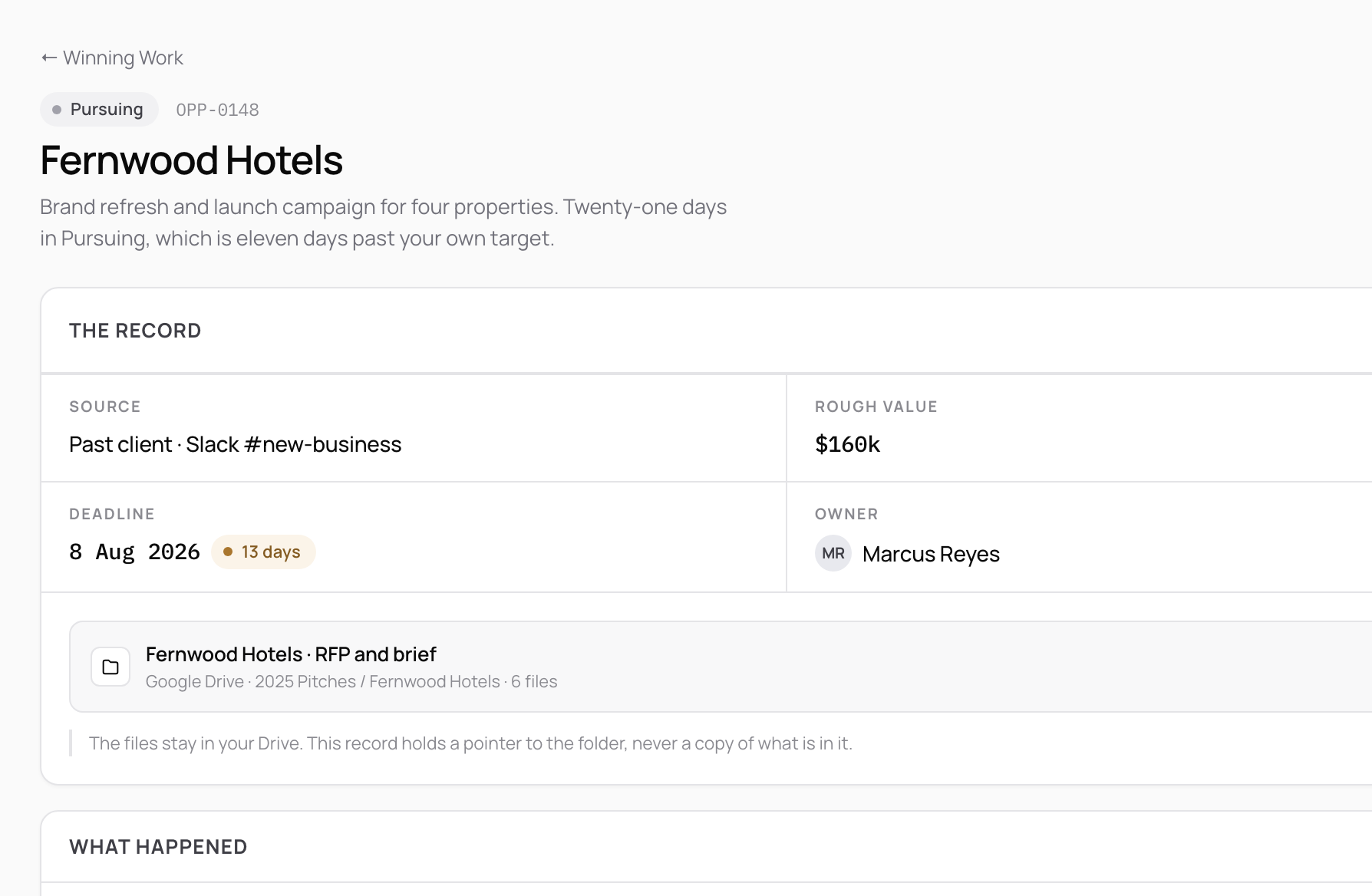
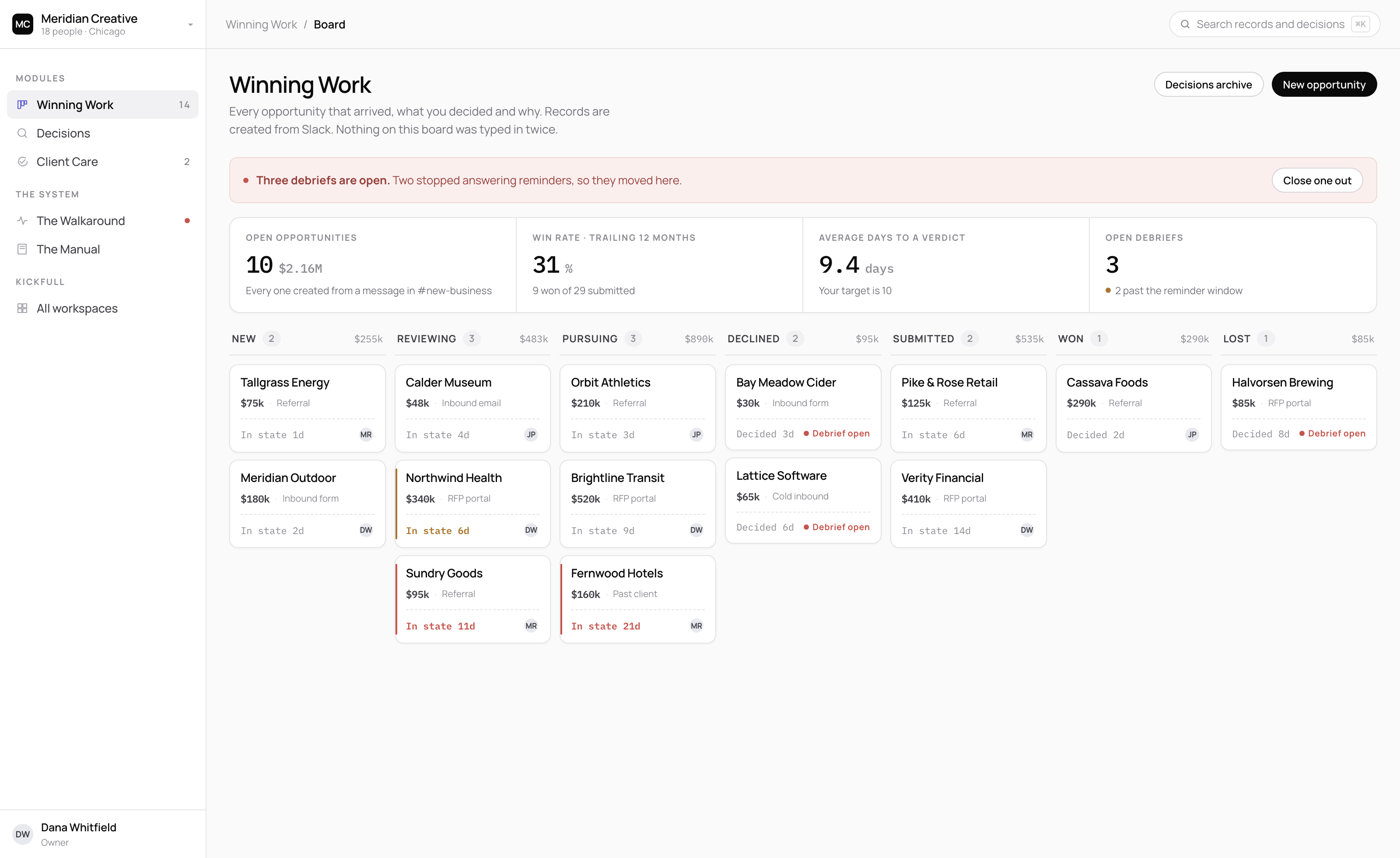
An RFP lands in your new-business channel. Runbook files the attachment into the standard Drive folder, creates a draft record and replies in the thread to ask whether that is right. The message carries two buttons, Pursuing and Not pursuing. Whoever knows, taps.
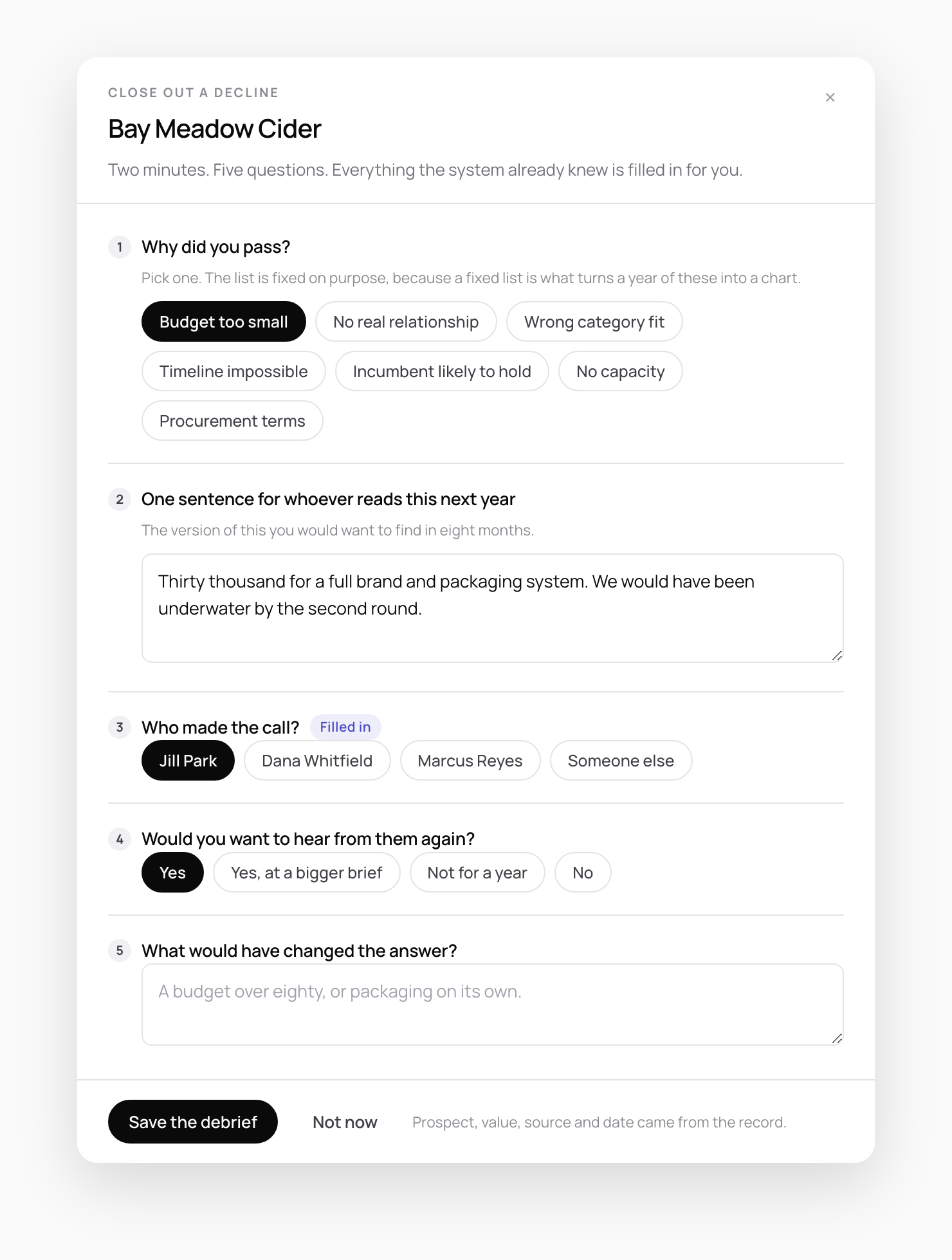
Tapping Not pursuing sends that person a debrief that is already half filled in. Five questions, two minutes, and it never asks for anything the system already knows. The reason comes off a fixed list, which is the part that matters, because a fixed list is what turns a year of these into a chart.
The notes come off the call. Runbook matches the attendees to a client and an account person, drafts a synopsis, reads the tone and pulls out the follow-ups with a suggested owner and a date on each one. Then it stops and asks.
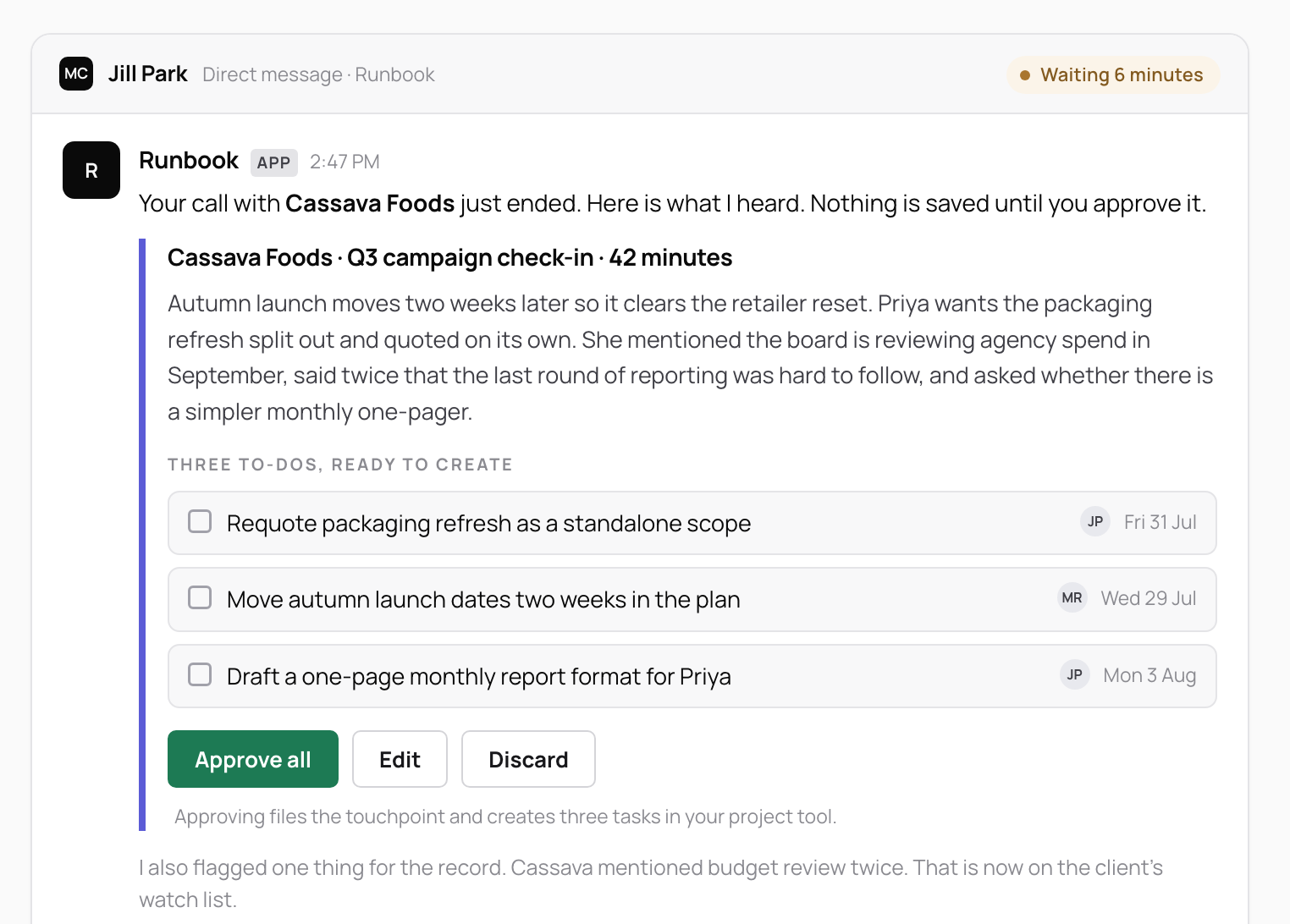
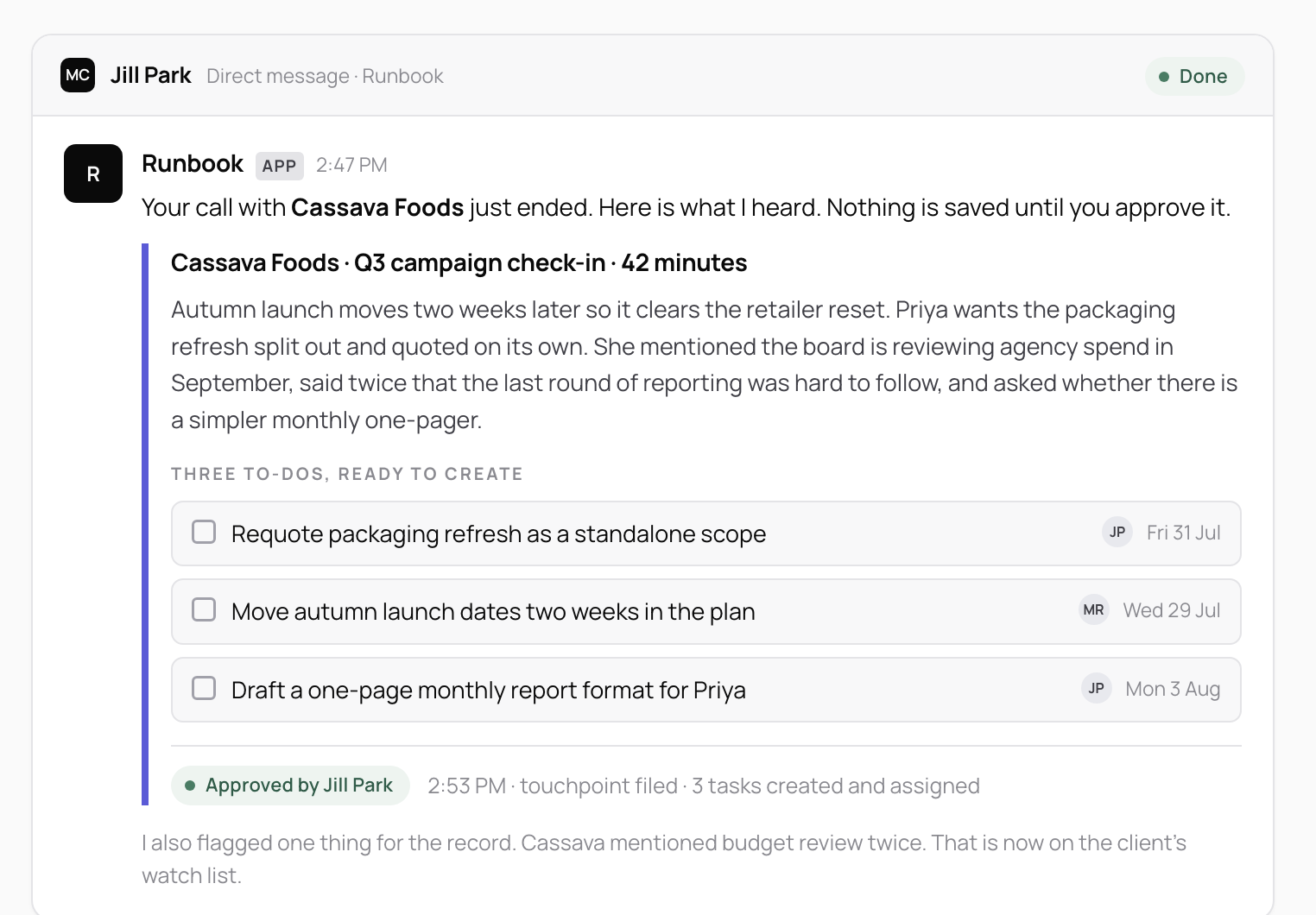
Nothing is written to your systems until somebody taps approve. Not the client record, not the task list, not anything a client will see.
Four numbers above the board and no more. Every one is computed from records the system made on its own. If a number would need somebody to remember to update it, it is not on the page.
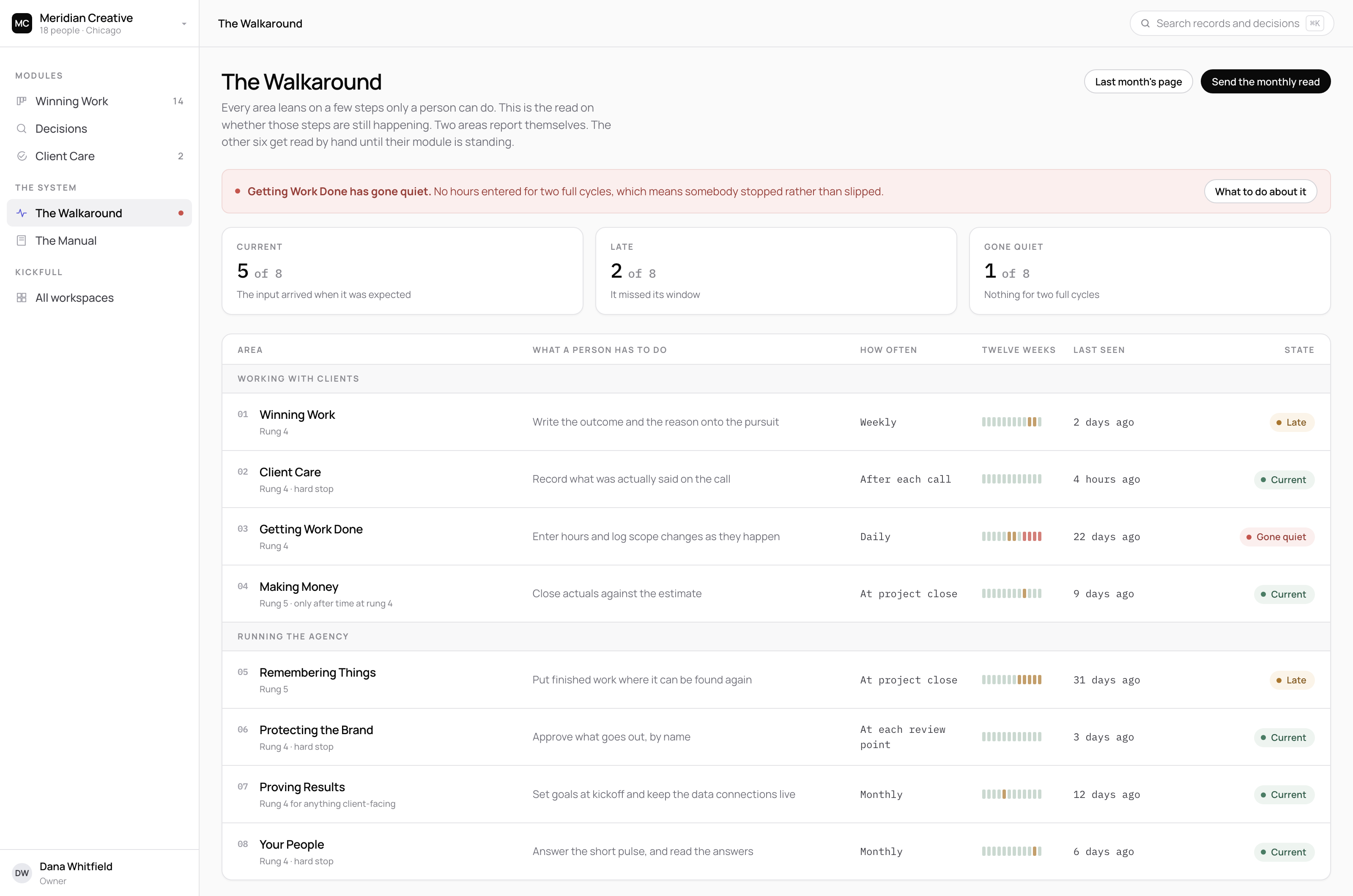
Underneath is the Lookout, which is the read on whether the few steps only a person can do are still happening. Each area is Current, Late or Gone quiet. Gone quiet is the one that matters, because it means somebody stopped rather than slipped, and a system nobody feeds keeps producing confident output from stale information.
A familiar prospect emails again. You type their name and there is the record from last spring, with the one sentence somebody on your team wrote at the time about why you passed, who made the call and what would have changed the answer.
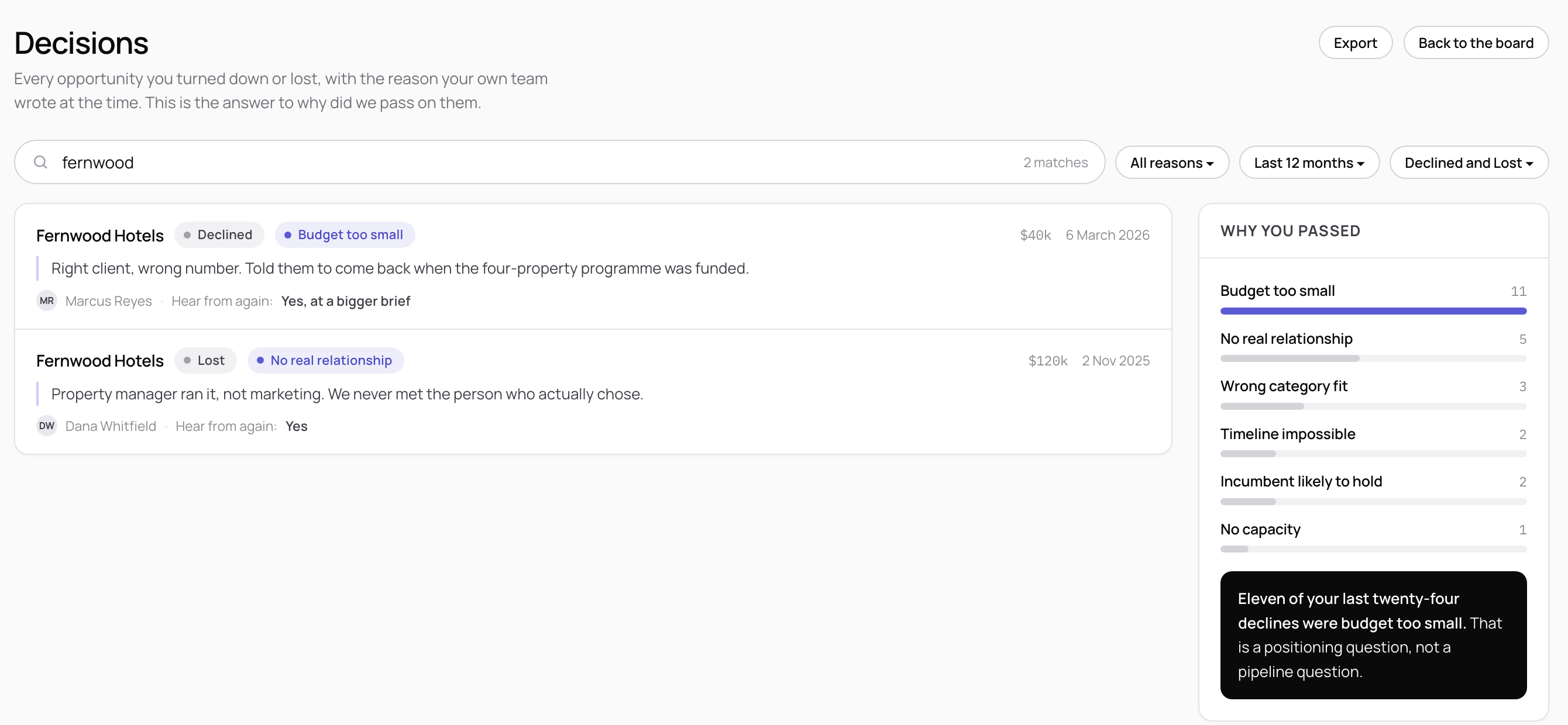
Because the reasons come off a fixed list, a year of them becomes a chart. Eleven of the last twenty-four declines being budget too small is not a pipeline observation. It is a positioning one, and no agency I have worked with has it today.
Six of the eight areas are capped at the rung where a named human still approves anything that goes out, and I intend to keep them there.
Your clients are paying for your judgment, and a system that quietly replaces it is a system that eventually embarrasses you in a room you are not in. So I gate the writes and leave the drafting alone. A draft nobody approves costs you nothing, which is why the machine can be aggressive about drafting and strict about writing.
The volume is the part most of these promises get wrong. One approval after a call is a decision you will actually read. Twelve approvals a call is a button you start pressing without looking, and then the gate is worth nothing at all. One message, three choices, four minutes from call to approved.
A person does every step. The process lives in memory.
People use AI on their own. Nothing is shared or repeatable.
The right history, rules and source material are current and findable.
Routine work starts, gathers context and checks itself. Uncertainty goes to a named person.
Outcomes feed back into a narrow internal system so it can improve over time.
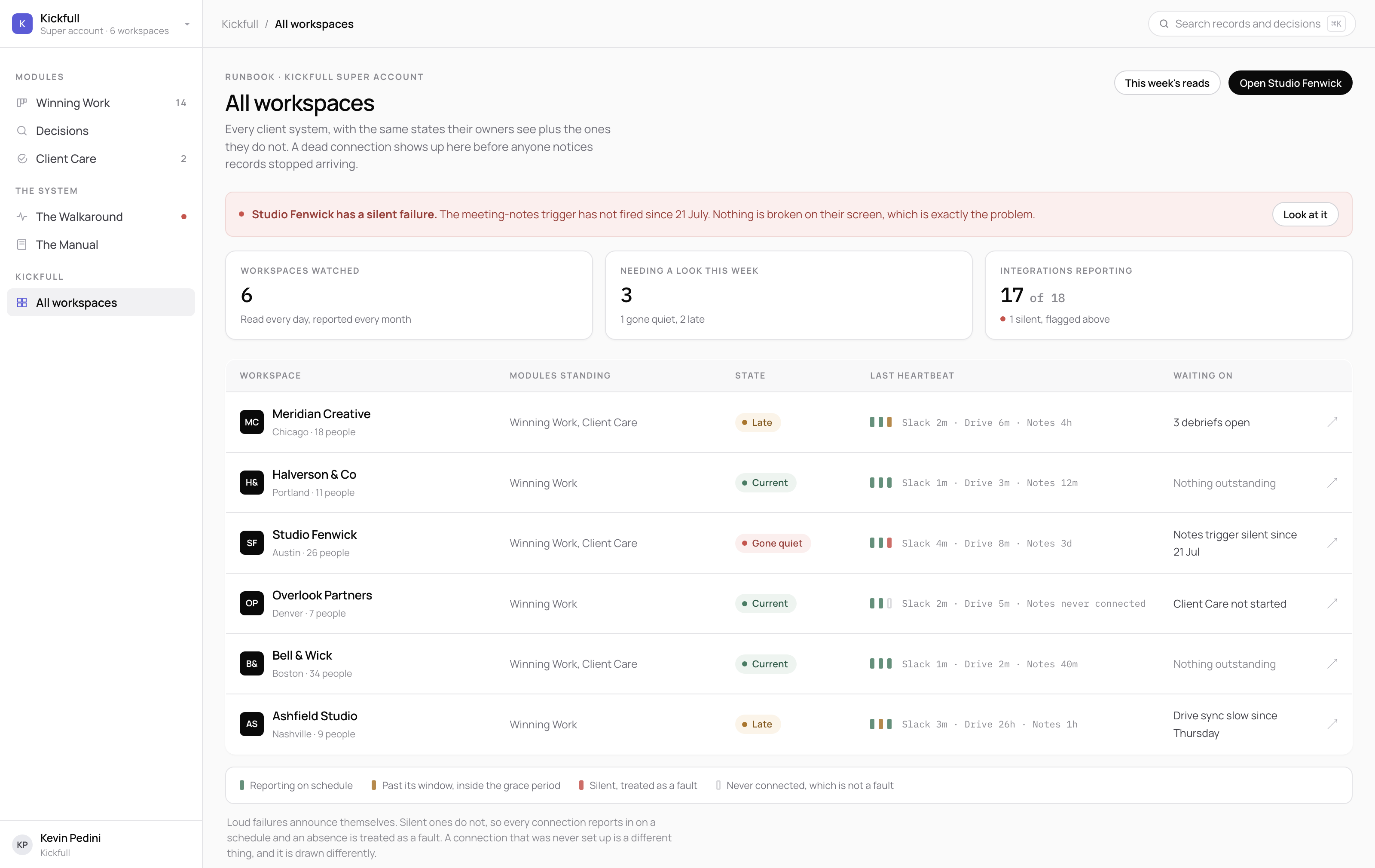
One page per module, in plain language. What it tracks, what runs on its own, what a person has to do and when, who owns it by name, and what the state is actually measuring. When a state slips, it links straight to the page explaining what slipped and how to fix it. I maintain the shared text and push it to every workspace. You add your own notes underneath.
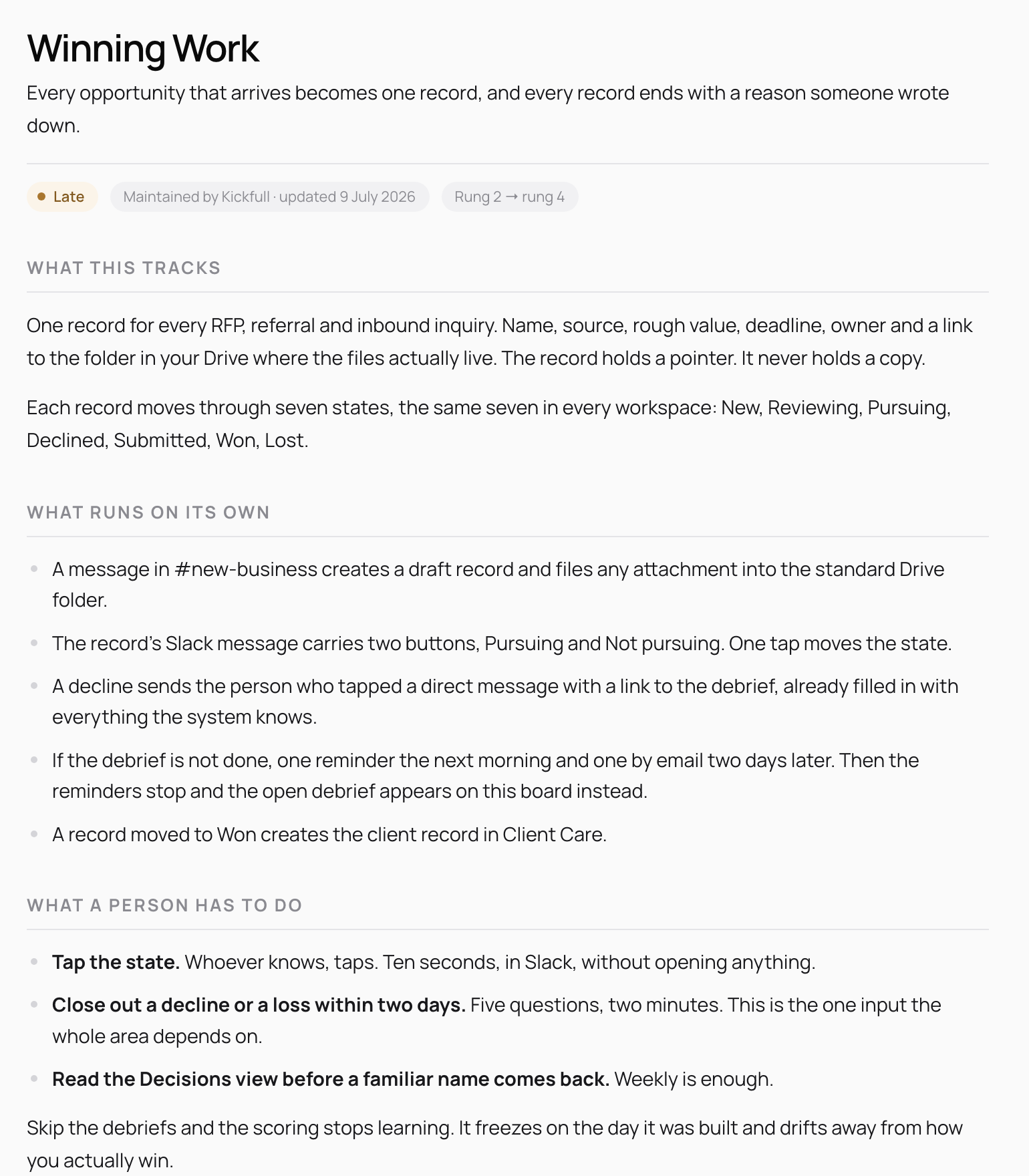
One login shows me every workspace, with the same three words the owners see plus the ones they do not. When a connection last synced. Whether an automation has gone silent. Loud failures announce themselves. Silent ones do not, so every connection reports in on a schedule and an absence is treated as a fault.
Software on its own does not change how people work, and one person cannot watch eight areas daily. That division is the whole offer, and it is why Runbook comes with the ongoing work rather than instead of it.
Why did we pass on them in 2024?
Why did we lose the last three pitches over two hundred thousand?
How many of our declines were actually about money?
How long does it take us to decide, on average?
Which referrals turn into real work?
What did the client say on the call before it went wrong?
Who agreed to that, and when?
How many opportunities are sitting untouched right now?
What did we promise on Tuesday, and who owns it?
Which of our own commitments went past their date last month?
Is anyone still filing finished work where it can be found?
What has quietly stopped working?
None of these need a new tool. They need the answer to have been written down on the day it was still cheap to write.
You can put Winning Work in front of your team this month. Everything on this page that is not Winning Work or Client Care is something I have not built yet, and I have written it that way on purpose.
Standing in a real workspace, reporting themselves every day.
Every module is the same five moves. That is why the eighth one is cheap. Most of the cost was paid building the first.
No dates. I will not give you one I cannot hold.
Buy Winning Work for what it does this month. If I never shipped another module you should still be ahead, and if that is not true then I have scoped it wrong.
Twenty-seven years on the agency side, and the same thing was true in every one of them. The people were good and the memory was terrible. I watched capable teams rebuild a proposal from an old deck because nobody could find the last one. I watched a producer reconstruct a week from Slack to write a status report. I watched an estimate get priced from somebody’s gut while the four jobs that would have answered the question sat in four different folders.
None of that was a technology problem, and it is not one now. AI did not fail agencies. Agencies never had their own information in a shape anything could read, including the people who work there.
So I started at the smallest honest place. One record, one lifecycle, one approval, in the tool people already have open. Then I built it again for the next area. I would rather ship one module you use every day than eight you looked at once.